
Remodeling SEO is essential for contractors to attract high-intent leads and stay competitive in the digital age. Homeowners often search online for services like "kitchen remodeling near me", and ranking on page one of search results can make or break your business. Here’s why SEO matters and how to get started:
- 98% of people search for local businesses online, and the top three organic results capture over 54% of clicks.
- SEO helps you connect with homeowners ready to hire, building trust and credibility through visibility in organic search and Google Maps.
- Unlike paid ads, SEO offers long-term benefits, delivering consistent leads even during slow seasons.
To succeed, focus on four key areas:
- Google Business Profile (GBP): Optimize for local searches with detailed services, photos, and reviews.
- On-Page SEO: Create service-specific pages with clear keywords, engaging content, and optimized titles.
- Technical SEO: Ensure your site loads quickly, is mobile-friendly, and follows best practices for search engines.
- Local SEO: Build location-specific pages and maintain consistent business information (NAP) across directories.
SEO takes time – 6–12 months for new businesses and 3–6 months for established ones – but it’s a proven way to generate leads and stand out in a crowded market.
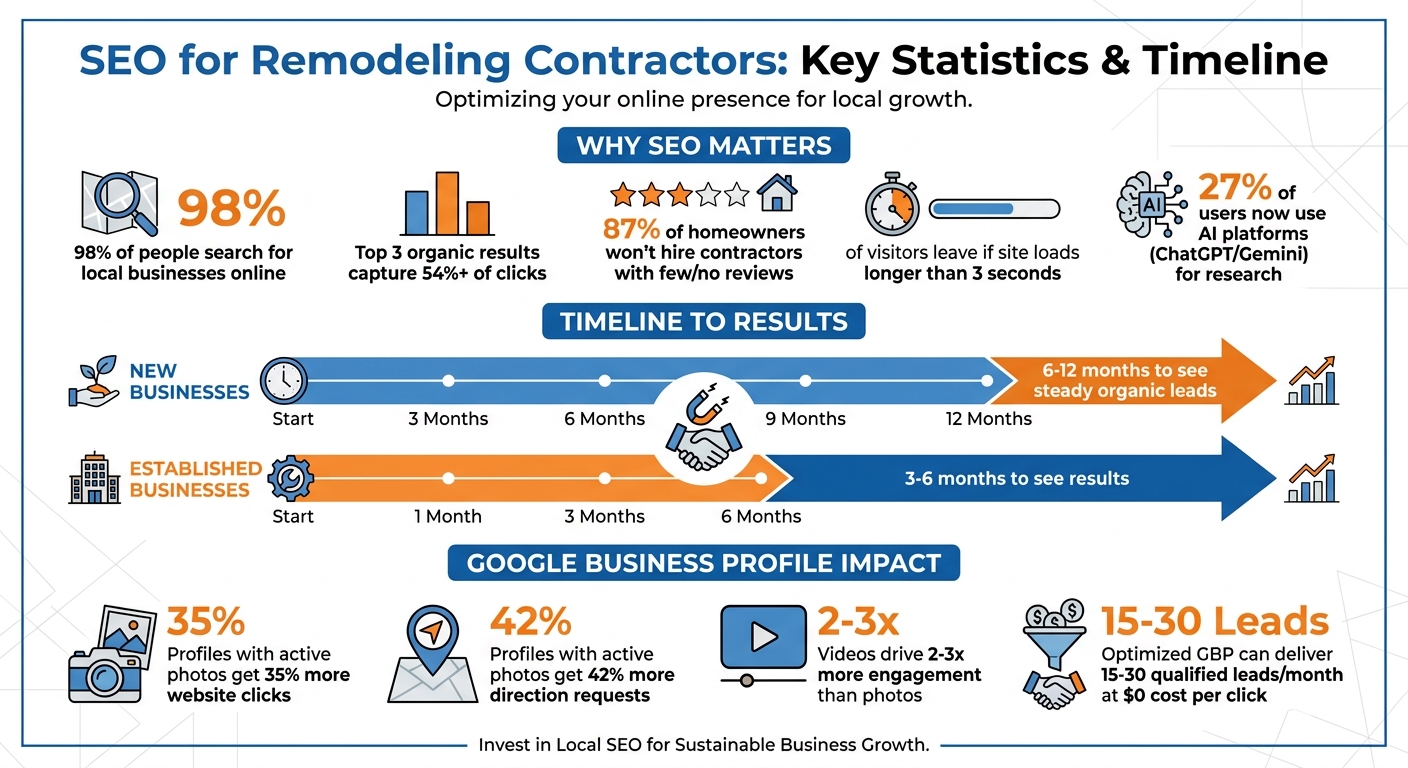
SEO Statistics and Timeline for Remodeling Contractors
Easy, Tactical SEO Tips for Remodelers & Contractors (De-Mystifying SEO)
sbb-itb-c45215a
4 Core Elements of Remodeling SEO
Success in the remodeling industry isn’t about mastering just one aspect of SEO – it’s about blending four essential elements that work together to increase visibility and build trust. These components – Google Business Profile optimization, on-page SEO, technical SEO and site health, and content strategy – create a solid digital foundation, helping you connect with potential clients at every stage of their decision-making process.
Each element plays a specific role: your Google Business Profile (GBP) ensures you’re visible in local searches, on-page SEO aligns your website with search engine algorithms, technical SEO keeps your site running smoothly, and content establishes authority to turn visitors into clients. Together, they amplify each other’s impact. As Chris Robinson from Full Scope Creative explains:
"Technical SEO is like the plumbing and wiring in a house. You might not see it, but if it’s not done right, nothing else works the way it should."
Let’s dive into each element and how you can use it effectively.
Google Business Profile Optimization
Your Google Business Profile is the cornerstone of your local online presence. When homeowners search for "kitchen remodeler near me", the Map Pack – the three businesses displayed with map pins – appears above all organic results. To land in this coveted spot, an optimized GBP is essential.
Start by selecting the right primary category – options like "Kitchen & Bath Remodeler" or "Home Remodeling Contractor" are ideal. Add secondary categories to expand your reach without diluting your focus.
Next, use the Services and Products sections to provide detailed descriptions. Instead of simply listing "Kitchen Remodeling", elaborate with 200-300 characters: "Complete kitchen transformations, including custom cabinetry, countertop installation, flooring, lighting upgrades, and layout redesigns. We handle permits, design, and construction from start to finish." This level of specificity helps Google match your profile to detailed homeowner searches like "tub-to-shower conversion contractor".
Visual content is a game-changer in the remodeling industry. Homeowners want to see examples of your work before reaching out. Upload 10-15 before-and-after photo sets per service type, along with team photos and short project walkthrough videos (30-60 seconds is ideal). Profiles with active photo uploads receive 35% more website clicks and 42% more direction requests. Videos, in particular, drive 2-3 times more engagement than photos.
Reviews are another critical factor. Aim for at least 25-50 reviews in smaller markets or 100-200+ in larger, competitive areas, maintaining a star rating of 4.7 or higher. Encourage clients to mention specific services and neighborhoods in their reviews, and respond to every review within 48 hours. For example: "Thank you for trusting us with your Lincoln Park kitchen remodel. We’re thrilled you love the new island!".
Don’t forget the Q&A section. Populate it with common homeowner questions, such as "Do you handle permits?" or "What’s the typical timeline for a bathroom renovation?" This not only saves time for potential clients but also signals relevance to Google.
An optimized GBP can deliver impressive results – up to 15-30 qualified leads per month at no cost per click. For example, in 2025, SuperFast Kitchen & Bath partnered with Chuckwalla Digital to refine their GBP, leading to a surge in inquiries and visibility in the Map Pack.
| Profile Element | Optimization Strategy | Impact on Rankings |
|---|---|---|
| Business Name | Use exact legal name (no keyword stuffing) | Very High |
| Primary Category | "Kitchen & Bath Remodeler" or "Home Remodeling Contractor" | Very High |
| Secondary Categories | Add relevant ones (e.g., "Cabinet Maker", "Tile Contractor") | High |
| Service Area | Define specific cities/zip codes (up to 20) | High |
| Photos | 10-15 before/after sets; 15-20 per project type | High |
Once your GBP is optimized, the next step is to refine your website’s on-page SEO.
On-Page SEO for Remodeling Websites
On-page SEO ensures your website aligns with the way homeowners search for services. It’s about making your content clear and relevant to both users and search engines.
Start with title tags, which are the clickable headlines in search results. These are critical for rankings. Make them specific, like "Kitchen Remodeling Contractor in Chicago" or "Bathroom Renovation Services | Austin, TX." This clarity helps both Google and potential clients understand your services.
Meta descriptions don’t directly impact rankings but can boost click-through rates. Think of them as mini ads. For instance: "Transform your outdated kitchen into a modern masterpiece. Licensed, insured, and serving Chicago homeowners since 2010. Free estimates." Include a call to action and highlight what sets you apart.
Your page’s H1 header should focus on your primary keyword combined with a compelling message, such as "Expert Kitchen Remodeling Services in Denver." This approach signals both expertise and location relevance.
For each service – whether it’s kitchen remodeling, bathroom renovations, or home additions – create dedicated service pages with 800-1,200 words of detailed content. Explain your process, showcase examples, and answer common questions.
Geographic pages are also crucial. Develop unique pages for each city or suburb you serve, and avoid using cookie-cutter templates. Instead, include references to local landmarks, renovation trends, or permit requirements. For example, a "Kitchen Remodeling in Naperville" page might mention popular styles in the area or recent projects in specific neighborhoods.
Don’t overlook image optimization. Rename files before uploading – use descriptive names like "luxury-kitchen-remodel-chicago.jpg" instead of generic ones like "IMG_1234.jpg." Add alt text that describes the project, such as "Modern marble kitchen island with waterfall edge in Austin home." This improves your chances of appearing in image searches.
Finally, use internal linking to connect your content. For example, link a blog post about kitchen trends to your "Kitchen Remodeling in Phoenix" page using anchor text like "our Phoenix kitchen remodeling services".
| On-Page Element | SEO Impact | Best Practice for Remodelers |
|---|---|---|
| Title Tag | High (Ranking) | Include [Service] + [City, State] |
| Meta Description | Medium (CTR) | Add a call to action and unique selling points |
| H1 Header | High (Context) | Use the primary keyword prominently |
| Alt Text | Medium (Images) | Describe the project in detail |
| Internal Links | Medium (Crawlability) | Link to relevant service pages |
With your on-page SEO in place, the next step is ensuring your site’s technical infrastructure supports these efforts effectively.
Local SEO Strategy for Remodeling Contractors
Local SEO is the key to getting noticed by homeowners in your service area. Unlike national brands, your success depends on being visible to people searching for remodeling services nearby. By combining local SEO tactics with on-page and technical SEO, you can create a strategy that attracts high-intent leads.
Service and Location Page Optimization
Picture your website as a grid. On one axis, you have your service areas, and on the other, the services you offer – like kitchen remodeling, bathroom renovations, or home additions. Every intersection of a service and location deserves its own dedicated page.
For instance, if you serve Phoenix, Scottsdale, and Tempe, and you offer three core services, you should create nine pages such as "Kitchen Remodeling in Phoenix", "Bathroom Renovations in Scottsdale", and "Home Additions in Tempe." Each page should link to broader service and location pages, creating an interconnected structure.
"Think of your website like a grid. The x-axis is your locations. The y-axis is your services. Every intersection point is a potential location-specific service page." – SMB Rank
Focus on hyper-local content that goes beyond simply swapping city names. Include details like popular neighborhood styles, local landmarks, and information on city-specific building codes or permit offices. For example, a "Kitchen Remodeling in Austin" page might highlight popular designs in Zilker or Travis Heights and mention the local permitting process.
Use internal links to create silos that help search engines understand your site’s structure. Add sections like "Other Services in [City]" to link to your other offerings in that area. This reinforces your authority in the region. Additionally, include links to nearby suburbs in your footer to expand your geographic presence. Use the HomeAndConstructionBusiness schema on your homepage and the areaServed property to reference your service area pages.
| Page Type | Primary Focus | Key Elements |
|---|---|---|
| Cornerstone Location | Geographic Authority | Local landmarks, permitting info, neighborhood references |
| Cornerstone Service | Topical Authority | Broad service descriptions, high-intent keywords (e.g., "Kitchen Remodeling") |
| Intersection Page | Hyper-Local Intent | Service + City keywords, local housing styles, lateral links to other local services |
Once your service and location pages are optimized, it’s time to align your business information across the web to further strengthen your local presence.
NAP Consistency and Local Citations
Consistency in your business details is critical for building trust and improving local SEO. NAP stands for Name, Address, and Phone Number, and this information must match exactly across every online directory, social media profile, and listing. Even small variations, like using "Ave" instead of "Avenue", can confuse search engines and weaken your authority.
"Even ‘Ave’ vs. ‘Avenue’ can confuse Google." – Ivan Vislavskiy, Founder & CEO, Comrade Digital Marketing
To ensure consistency, focus on four layers of citations:
- Core Directories: Start with platforms like Google Business Profile, Bing Places, Apple Maps, Yelp, BBB, Angi, and Houzz.
- Industry-Specific Listings: Add your business to sites like NAHB, NARI, Houzz Pro, GuildQuality, and Porch.
- Local and Regional Listings: Look for opportunities with your Chamber of Commerce, local builder associations, or city business journals.
- General High-Authority Directories: Include platforms like Yellow Pages, Manta, Foursquare, and Superpages.
If you use call tracking numbers, list the tracking number as the primary contact on your Google Business Profile and your main business line as the secondary number to avoid inconsistencies. Tools like BrightLocal, Whitespark, or Yext can help manage your NAP details across multiple platforms. Additionally, running a citation audit on competitors and using data aggregators like Data Axle or Neustar Localeze can further enhance your strategy.
| Citation Layer | Examples for Remodelers |
|---|---|
| Core Directories | Google Business Profile, Bing Places, Apple Maps, Yelp, BBB, Angi, Houzz |
| Industry-Specific | NAHB, NARI, Houzz Pro, GuildQuality, Porch |
| Local & Regional | Chamber of Commerce, local builder associations (HBA), city business journals |
| General High-Authority | Yellow Pages (YP.com), Manta, Foursquare, Superpages, Hotfrog |
Costs for citations vary. Smaller local directories might cost $50–$100, mid-tier associations range from $100–$200, and state or national-level organizations can run $300–$500.
Review Management Strategies
Online reviews are essential for both search rankings and building trust with potential clients. In fact, 87% of homeowners will not hire a contractor with few or no online reviews. Google uses reviews as a ranking factor for local search, and homeowners rely on them to decide who to contact.
"Positive reviews are gold for your SEO success. Every happy client = one more reason Google (and homeowners) trust you." – Ivan Vislavskiy, Founder & CEO, Comrade Digital Marketing
Aim for a steady flow of reviews rather than occasional bursts. Create a system to request reviews consistently. For example, ask for a review in person during the final walkthrough when the homeowner is thrilled with the results. Follow up with an email or SMS containing a direct link to your Google Business Profile for easy access.
Encourage clients to mention specific services and neighborhoods in their reviews to boost local relevance. For instance, a review stating, "Our kitchen remodel in Scottsdale was seamless", can help reinforce your presence in that area. Customer-uploaded photos of completed projects also drive higher engagement and click-through rates.
Respond to every review promptly and personally. Acknowledge positive feedback by referencing specific project details, and handle negative reviews with thoughtful, individualized responses to show professionalism and build trust.
Highlight reviews and testimonials on your service-specific pages and portfolio to convert visitors into leads. As discovery continues to evolve across platforms like Google Maps, Houzz, and Yelp, maintaining consistent and positive review signals across the web is crucial for building your reputation.
SEO Tools and Resources for Remodeling Contractors
Having the right tools can simplify SEO efforts significantly. You don’t need to invest in every tool out there – start with the basics to research keywords, monitor your website’s health, and track your local visibility. Many tools offer free versions or trials, so you can experiment and find what works best for your business before committing to a subscription. Below are some essential tools to get you started.
Keyword Research Tools
Understanding how homeowners search for remodeling services in your area is the first step to finding the right keywords. Google Keyword Planner is a free tool that provides monthly search volume and trends for terms like "kitchen remodeling Phoenix" or "bathroom renovation near me." While you’ll need a Google Ads account to access it, running ads isn’t required. You can also filter results by state or city to see what services are in demand locally.
For more detailed insights, Semrush‘s Keyword Magic Tool offers volume estimates and keyword difficulty scores. Another option is Ubersuggest, which provides SEO difficulty metrics and reveals common homeowner questions. Ubersuggest allows three free searches per day, with paid plans available for additional features.
Free tools like Google Autocomplete and the "People Also Ask" section can help you discover the specific phrases homeowners use when searching. Additionally, digging into your own CRM, email conversations, or consultation notes can reveal the language your clients use – these insights often uncover high-intent keywords that your competitors might overlook.
"Google Keyword Planner remains one of the most underrated… it’s a powerful and free tool that every SEO should leverage for keyword discovery and strategy." – Neil Patel, Co-Founder, NP Digital
Once you’ve identified the right keywords, the next step is ensuring your website performs well.
Website Performance and Technical SEO Tools
A strong keyword strategy is only effective if your website delivers a seamless experience. Start by ensuring your site loads quickly across all devices. Google PageSpeed Insights can pinpoint issues slowing your site down – important, since websites taking over 3 seconds to load risk losing 40% of visitors.
Google Search Console is another essential tool, helping you monitor your site’s health by flagging indexing issues or technical errors that could prevent your pages from showing up in search results. Pair this with Google Analytics to track user behavior and conversions. Together, these free tools give you a well-rounded view of your website’s performance.
With the rise of AI-driven search platforms like ChatGPT and Gemini, it’s also worth exploring tools that track your visibility in these spaces. Tools like SE Ranking’s AI Overview Tracker, Keyword.com’s AI Visibility Monitor, and ZipTie.dev can show whether your business is being recommended when homeowners seek remodeling advice through AI platforms. With 27% of users now favoring AI over traditional search engines, this is an area worth monitoring.
Local SEO Tools
After refining your keyword strategy and website performance, focus on managing your local presence. Appearing in the map pack is crucial, as many homeowners rely on it when choosing contractors.
Start by optimizing your Google Business Profile and ensuring your business information – Name, Address, and Phone number (NAP) – is consistent across all online directories. Tools like BrightLocal and Whitespark specialize in local SEO. They help you track your profile rankings, manage citations, and monitor reviews across platforms.
These tools can also uncover new citation opportunities. For example, BrightLocal can run a citation audit on your competitors to identify where they’re listed, giving you ideas for expanding your own local presence. While these tools often require a subscription, they save time and help maintain the accuracy needed to build trust and authority in your local market.
Implementing Your Remodeling SEO Strategy
SEO strategies that actually work for contractors aren’t a one-and-done deal – it’s an ongoing process. As mentioned earlier, your Google Business Profile (GBP), on-page optimizations, and review system are the foundation of a strong SEO strategy. If you’re just starting, be patient. It can take 6–12 months to see a steady stream of organic leads. For contractors with some online presence already, results might show up faster – within 3–6 months.
Key Takeaways for Remodeling Contractors
To build trust and increase visibility, focus on what matters most. Start by fine-tuning your Google Business Profile. Use accurate categories, share updates about recent projects, and upload high-quality images to attract more clicks. When it comes to your website, create specific landing pages for each service you offer. For example, have separate pages for "kitchen remodeling" and "bathroom renovation" instead of combining everything under a generic "Services" page. Homeowners aren’t searching for "general remodeling contractor" – they’re looking for specific solutions.
Don’t forget about the technical side of your website. A slow-loading site can cost you big – 40% of visitors will leave if your site takes longer than 3 seconds to load. Use tools like Google PageSpeed Insights to diagnose and address speed issues. Lastly, make it easy for clients to leave reviews right after finishing a project. Positive reviews are crucial for building trust. In fact, 87% of people won’t hire a contractor with few or no reviews.
Once these basics are handled, you can shift your focus to fine-tuning your online presence.
Next Steps for Improving Online Visibility
Now that you’ve covered the essentials, it’s time to take things up a notch. Begin by auditing your online presence. Make sure your business details – like name, address, and phone number – are consistent across all directories. Next, create content that answers common homeowner questions, such as "How much does a kitchen remodel cost in [Your City]?" This type of content not only ranks well in traditional search engines but also helps you appear on AI-driven platforms like ChatGPT and Gemini, where 27% of users now conduct research.
Keep an eye on metrics that tie directly to revenue, such as calls from your Google Business Profile, form submissions, consultation bookings, and signed contracts. Tools like Google Analytics and Google Search Console can help you track keyword performance and spot opportunities to fill content gaps. SEO is an ongoing cycle of tracking, tweaking, and refining. Use your data to zero in on what brings in the most valuable leads.
FAQs
Which remodeling services should I target first with SEO?
If you’re looking to boost your SEO, consider targeting services that homeowners frequently search for in your area – like kitchen and bathroom remodeling. These projects are often at the top of homeowners’ to-do lists, making them a hot topic in local searches.
By centering your strategy around these high-interest categories, you can enhance your presence in local search results and draw in more qualified leads who are actively seeking these services.
How do I choose the best service areas to focus on?
When it comes to reaching homeowners in need of remodeling services, focus your efforts on areas with strong demand and intent. These are places where people are actively searching for terms like "kitchen remodel near me."
Start by identifying neighborhoods or cities with a high search volume for remodeling services. Once you’ve pinpointed these areas, prioritize locations where the competition isn’t overwhelming. This balance allows you to stand out without spreading your resources too thin.
To build a strong local presence, invest in localized content that resonates with homeowners in your target areas. Encourage satisfied clients to leave positive reviews, and ensure your business is listed in relevant local directories and citations. These steps not only boost visibility but also establish trust with potential customers.
By concentrating on high-potential areas, you can generate more local leads and increase your visibility where it matters most. Avoid trying to cover too many locations at once – focus on quality over quantity for the best results.
What metrics should I track to show SEO is driving leads?
If you want to prove that your SEO efforts are bringing in leads, focus on these key metrics:
- Organic traffic: Keep an eye on how many visitors are landing on your site directly from search engines. A steady increase here often signals better rankings.
- Keyword rankings: Track your performance for local keywords, such as "kitchen remodel near me." This will help you see how visible your business is for relevant searches.
- Leads: Measure actions like contact form submissions, phone calls, or bookings – these are direct indicators of interest from potential customers.
- Local visibility: Use tools like Google My Business insights to monitor how often your business appears in local searches or the map pack.
- Reviews: Pay attention to the number and quality of reviews your business gets. Positive reviews not only build trust but can also lead to more inquiries.
By focusing on these metrics, you’ll have a clear picture of how SEO is contributing to your lead generation efforts.