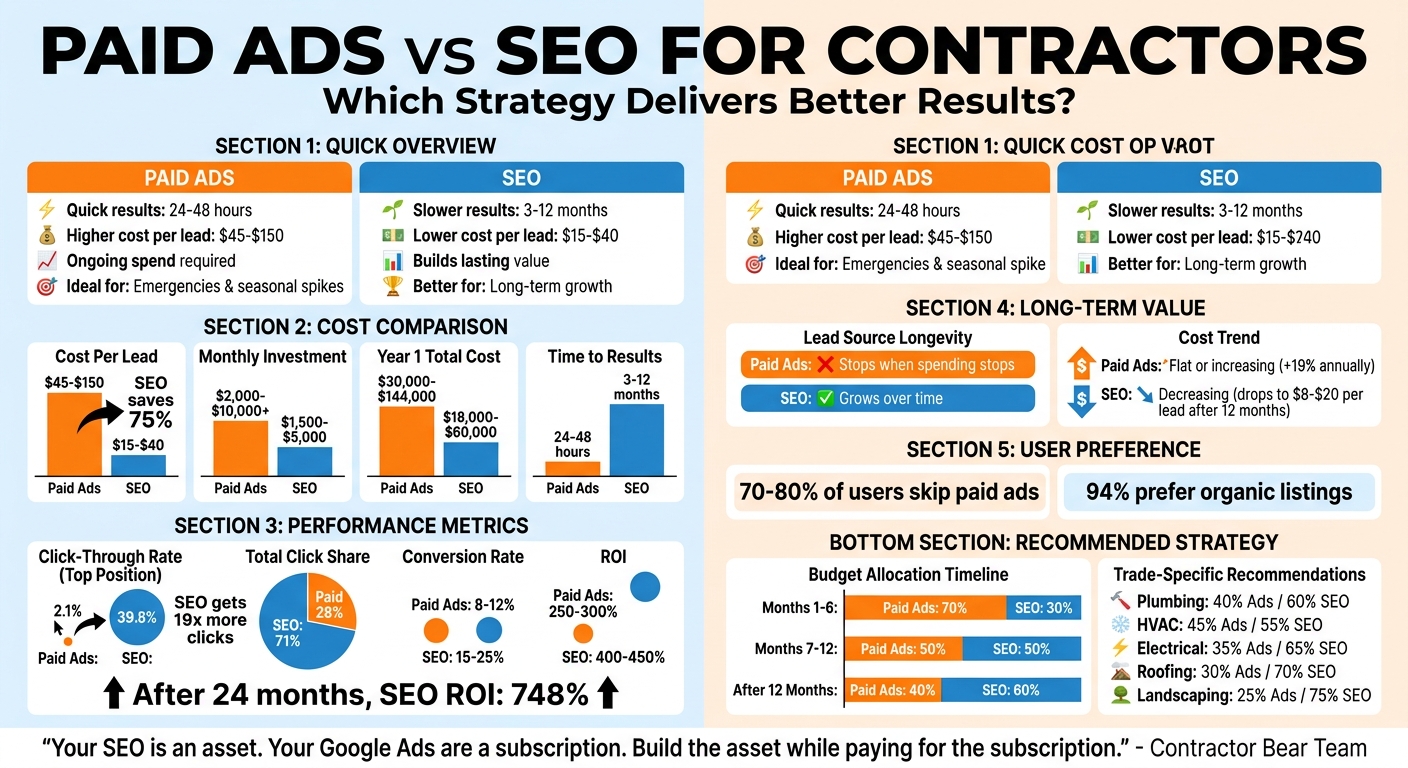
If you’re a contractor deciding between paid ads and SEO, here’s the bottom line: paid ads deliver leads fast but at a higher cost, while SEO takes time to build momentum but provides cheaper leads and long-term benefits. The right choice depends on your current goals – whether you need immediate results or are planning for sustained growth.
- Paid Ads: Quick results (24–48 hours), higher cost per lead ($45–$150), ongoing spend required, and ideal for emergencies or seasonal spikes.
- SEO: Slower results (3–12 months), lower cost per lead ($15–$40), builds lasting value, and better for long-term growth.
Quick Comparison:
| Metric | Paid Ads | SEO |
|---|---|---|
| Cost Per Lead | $45–$150 | $15–$40 |
| Time to Results | 24–48 hours | 3–12 months |
| Monthly Spend | $2,000–$10,000+ | $1,500–$5,000 |
| ROI | 250–300% | 400–450% |
| Lead Source Longevity | Stops with spend | Grows over time |
For most contractors, a combined strategy works best: start with paid ads to secure immediate leads while investing in SEO for long-term growth. Over time, shift more budget to SEO as your rankings improve.
Paid Ads vs SEO for Contractors: Cost, ROI and Performance Comparison
SEO vs Paid Ads: Which Brings Better Leads for Contractors?
sbb-itb-c45215a
Cost Breakdown: Paid Ads vs SEO
Understanding your marketing expenses is essential for setting a realistic budget. Whether you invest in paid ads, SEO, or a mix of both, the costs and benefits vary significantly. Here’s a closer look at the financial details for each strategy.
Paid Ads: Higher Costs, Faster Results
Paid ads deliver quick results, but the price tag can add up fast. Contractors typically spend $2,000–$10,000+ per month on ads, along with $500–$2,000 in management fees.
The cost per lead is on the higher side, averaging $45 to $150. Local Service Ads, a popular choice, usually cost $65 to $95 per lead. If you’re targeting high-intent keywords like "AC repair", expect to pay $15 to $60+ per click. In large cities, construction-related keywords can cost even more – up to $25 to $75+ per click.
Over the first year, your total investment in paid ads could range from $30,000 to $144,000. Adding to this, Google Ads costs for contractors have seen an annual increase of about 19%.
SEO: Lower Costs, Delayed Returns
SEO requires patience, but it’s a more cost-effective option in the long run. Agencies charge $1,500–$5,000 per month, which typically includes services like content creation (around four blog posts), link building, citation management, and technical upkeep.
The cost per lead with SEO is much lower, averaging $15 to $40 – a savings of roughly 75% compared to paid ads. Once your SEO strategy gains traction after 12 months, this can drop even further to $8 to $20 per lead. First-year SEO investments generally range from $18,000 to $60,000.
Initial SEO efforts focus on technical audits, improving site speed, setting up your Google Business Profile, and creating foundational content. Unlike paid ads, these efforts build value over time. As one expert put it:
"SEO is the only marketing channel where your cost per lead goes down over time while your traffic goes up." – Digital Footprint Solutions
Cost Comparison Table
| Metric | SEO for contractors across every trade | Paid Ads (PPC) for Contractors |
|---|---|---|
| Average Cost Per Lead | $15–$40 | $45–$150 |
| Monthly Investment | $1,500–$5,000 | $2,000–$10,000+ |
| Year 1 Total Cost | $18,000–$60,000 | $30,000–$144,000 |
| Time to Results | 3–9 months | 24–48 hours |
| Long-term ROI | 400–450% | 250–300% |
| Cost Trend Over Time | Decreasing | Flat or Increasing |
Lead Generation: Traffic and Conversion Performance
When it comes to online clicks, organic search results dominate paid ads. The top organic listing grabs a staggering 39.8% click-through rate, compared to just 2.1% for the top paid ad. For local contractor searches, the Google Map Pack secures 42% of clicks, while organic website results take 29%. Paid ads trail slightly behind with 28%. Overall, more than 70% of users prefer unpaid results, with 70–80% actively skipping ads in favor of organic listings. For contractors, understanding these patterns is key to improving lead quality and maximizing ROI. Let’s break down how paid ads and SEO compare in driving traffic and conversions.
Paid Ads: Fast and Targeted, but Limited in Reach
Paid ads act like a quick-start engine for traffic. You can begin driving visitors to your site within 24–48 hours, targeting specific audiences based on location, time, and even intent. For instance, Local Services Ads (LSAs) are particularly effective for emergency needs – think burst pipes or broken air conditioners – delivering lead-to-job close rates between 25% and 31%.
However, the downside is clear: with a low 2.1% click-through rate, many users simply scroll past paid ads. On average, contractors see conversion rates of 8–12% through Google Ads. Another drawback? The moment you stop paying, the traffic disappears.
SEO: Trustworthy and Long-Lasting Results
SEO, on the other hand, builds credibility and trust. Organic rankings are seen as earned authority, which is why 94% of users prefer organic listings over paid ones. If your business ranks in both the Map Pack and organic results, you’re likely to capture the lion’s share of clicks. Plus, these visitors tend to convert at rates of 15–25%.
The catch? SEO is a long game. It typically takes 6–12 months to gain traction. But once established, it becomes a cost-efficient lead source. Over time, SEO traffic grows steadily, and by year two, organic leads often surpass paid ones at a much lower cost.
Traffic and Conversion Comparison Table
| Metric | Paid Ads (PPC/LSA) | SEO (Organic/Map Pack) |
|---|---|---|
| Click-Through Rate (Top) | 2.1% | 39.8% |
| Total Click Share | 28% (Combined) | 71% (Combined) |
| Conversion Rate | 8–12% | 15–25% |
| Time to Results | 24–48 hours | 3–12 months |
| Lead-to-Job Close Rate | 25–31% (LSA) | ~14% |
| User Trust Level | Lower (Paid Placement) | Higher (Earned Authority) |
When to Use Paid Ads vs SEO
Deciding between paid ads and SEO boils down to your goals: Do you need leads right now, or are you planning for steady, long-term growth? Let’s break it down.
Paid Ads: When You Need Quick Results
Paid ads are perfect for immediate lead generation. If you’re in a business where customers need help fast – like plumbing emergencies or broken AC units – Google Ads can connect you with leads in as little as 3–7 days. These situations are all about urgency, and customers often click the first result they see.
Paid ads also work well during seasonal spikes. For example, HVAC contractors can increase spending during summer heat waves, while roofers can run storm-related campaigns as needed. Even with high costs per click – like $50–$100 for roofing jobs or over $100 for emergency plumbing keywords – the margins on big-ticket services (e.g., $8,000–$25,000 roof replacements) make the expense worthwhile.
Paid ads are also great for testing new ideas. Whether you’re rolling out a new service or targeting a fresh geographic area, ads let you gauge demand quickly. To maximize results, consider raising bids during peak search times, like evenings (6–10 PM) and weekends, when emergency calls are most common.
SEO: Building for the Long Haul
SEO is your go-to for consistent, long-term lead generation. While it takes 4–12 months to gain momentum, the payoff is a steady stream of leads that doesn’t stop when you pause spending. Think of SEO as an investment that grows over time.
"Your SEO is an asset. Your Google Ads are a subscription. Build the asset while paying for the subscription, and eventually you’ll need less and less of the subscription." – Contractor Bear Team
SEO works especially well for services that require a lot of research. Take roofing or landscaping, for example – customers in these industries often spend time comparing portfolios and reading reviews before making a decision. Organic results tend to feel more trustworthy, with 70–80% of searchers skipping paid ads entirely. Plus, after a year, SEO can bring your cost-per-lead down to $8–$20, compared to $45–$150 for paid ads.
Using Both Strategies Together
The smartest approach? Combine both. Start with a heavy focus on paid ads (80% of your budget) to generate immediate cash flow, then gradually shift to SEO (60% of your budget) as your organic rankings improve over the first year. This strategy allows you to dominate search results by appearing in Local Services Ads, the Map Pack, and organic listings – potentially capturing up to 85% of clicks.
Paid ads can also boost your SEO game. Use ad performance data to discover high-converting keywords and top-performing locations, then prioritize those in your SEO content plan. Even if your organic rankings are strong, bidding on your business name ensures you don’t lose direct leads to competitors. Just make sure you have the right tools in place – like a CRM and automated follow-up system – since 70% of leads that don’t book immediately might slip through the cracks.
| Trade | SEO Budget % | Paid Ads Budget % | Reasoning |
|---|---|---|---|
| Plumbing | 60% | 40% | High emergency volume makes ads essential. |
| HVAC | 55% | 45% | Seasonal demand requires ad-heavy strategies. |
| Electrical | 65% | 35% | Planned projects align well with SEO. |
| Roofing | 70% | 30% | High-ticket jobs benefit from trust via SEO. |
| Landscaping | 75% | 25% | Low urgency; customers research extensively. |
Why SEO Wins for Long-Term Growth
While quick wins are important, the long-term benefits of SEO make it a powerful investment for sustained growth. SEO isn’t just another marketing strategy – it’s a business asset that keeps delivering value long after the initial effort. Unlike paid ads, which stop generating leads as soon as you stop funding them, SEO builds a foundation that grows over time. Each service page you publish, every positive review you receive, and each backlink you earn contributes to a compounding effect, driving down lead costs in a way that paid ads simply can’t match.
Consider this: after 24 months of consistent SEO work, the median ROI hits 748%. Compare that to the 250–300% ROI typically seen with PPC campaigns. Meanwhile, the cost of paid advertising continues to rise – Google Ads for contractors have seen an annual increase of about 19%.
SEO also positions your business for the future. AI-driven search tools increasingly prioritize organic content over paid ads. As more homeowners turn to voice assistants and AI tools to find contractors, having a strong organic presence ensures you remain visible. This forward-thinking approach also sets the stage for the next step: tailoring SEO strategies to your specific trade.
Trade-Specific SEO Gets Results
Trade-specific SEO zeroes in on the unique needs of your market. Most potential customers don’t search for broad terms like "home services." Instead, they’re looking for specific solutions – like diagnosing a water heater problem or finding emergency AC repair. These long-tail queries are often overlooked by general strategies, but they’re exactly what trade-specific SEO targets.
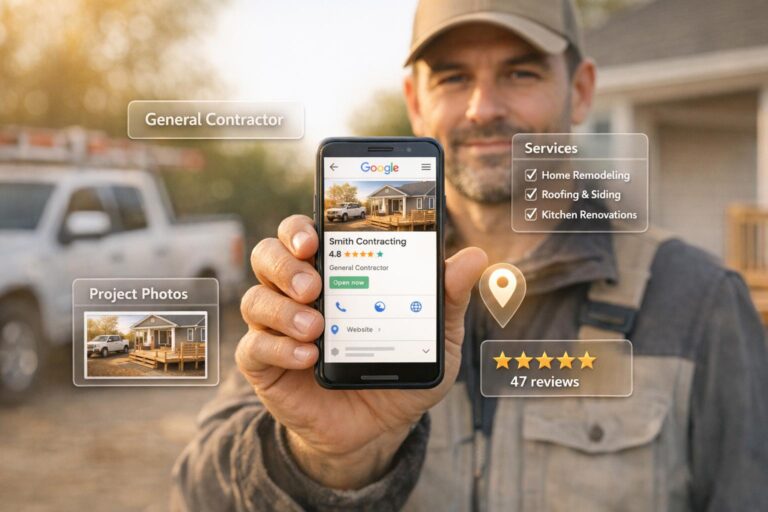
Contractor SEO Agency builds its strategies around four key elements of local SEO: optimizing your Google Business Profile, maintaining a steady flow of reviews (aiming for 100+ with a 4.8+ star rating), securing consistent local citations, and creating city-specific service pages. These tactics are customized based on your trade, market, and competition. For instance, roofing contractors benefit from detailed service pages, while plumbers need mobile-friendly sites that load quickly for emergency searches.
The Google Map Pack is a prime example of why local SEO matters – it captures 42% of all local search clicks. With a strong local SEO strategy, you can dominate this space and secure a significant share of clicks in your area.
Clear ROI with Monthly Reporting
To measure the long-term benefits of SEO, transparency in reporting is essential. Contractor SEO Agency provides monthly reports that focus on metrics that truly impact your business – like phone calls, booked appointments, and signed jobs – rather than surface-level data like impressions or clicks.
Dynamic Number Insertion (DNI) is used to track which organic keywords and service pages are driving your highest-value leads. This detailed tracking allows you to pinpoint which services are generating the most revenue, helping you prioritize efforts where they’ll have the most impact. It also helps identify when you can reduce spending on PPC as your organic rankings take over.
Monthly reporting also highlights the compounding benefits of SEO. In the early stages (months 1–3), the focus is on technical improvements and content creation, with minimal lead changes. By months 7–12, during the acceleration phase, you can expect a steady flow of 15–30 leads per month. By months 13–24, the dominance phase, your efforts can yield 40–70+ leads per month at a fraction of the cost of paid ads.
There are no long-term commitments – just a flexible, month-to-month service with complete transparency. You’ll always know how your marketing dollars are being spent and the results they’re delivering.
Conclusion: Picking the Right Strategy
To wrap things up, paid ads and SEO each bring their own strengths to the table. Paid ads deliver quick results, often within 24–48 hours, making them indispensable for new businesses or urgent services like plumbing emergencies or HVAC repairs. On the other hand, SEO builds a foundation for long-term growth, becoming a steady lead generator after 6–12 months and significantly lowering the cost per lead over time.
The numbers speak for themselves: SEO can deliver an ROI of 400–450% with conversion rates of 15–25%, while paid ads typically yield a 250–300% ROI with conversion rates of 8–12%. Plus, more than 70% of searchers bypass paid ads entirely in favor of organic results. This makes SEO not only more cost-effective but also more trusted by potential customers.
"Your SEO is an asset. Your Google Ads are a subscription. Build the asset while paying for the subscription, and eventually you’ll need less and less of the subscription." – Contractor Bear Team
A phased approach works best for most businesses. For the first six months, allocate 70% of your budget to paid ads and 30% to SEO to generate cash flow while building your organic presence. After 12 months, shift the balance to 40% ads and 60% SEO as your rankings and visibility grow. Businesses in emergency-driven industries like plumbing and HVAC might stick with a higher ad spend (40–45%), while industries like roofing and landscaping – where customers tend to research more – can focus more heavily on SEO (70–75%).
It’s also crucial to have the right infrastructure in place to maximize the impact of both strategies. A conversion-ready website, a reliable CRM, and quick call response times (ideally within 60 seconds) are non-negotiable. Without these, even the best marketing strategy will fall short. By combining the immediate revenue boost of paid ads with the long-term benefits of SEO, you can balance short-term growth with lasting market leadership.
FAQs
How do I know if my market is too competitive for SEO?
To figure out if SEO is a tough game in your market, start by looking at how many local businesses are going after the same keywords. For instance, think about phrases like "plumber near me." If search results are packed with well-established competitors, it means the playing field is crowded. This could mean SEO results might take longer to materialize.
In situations like these, pairing SEO with paid ads can be a smart move. While your website works on building authority, paid ads can help you stay visible and attract traffic in the meantime. It’s a balanced approach to staying competitive.
What budget should I start with if I can’t afford both SEO and ads?
If your budget is tight and you can’t afford both SEO and paid ads, consider starting small with paid ads to generate quick traffic and leads. Even with a budget of $200–$400 per month, you can see faster results while you work on building up your SEO strategy for long-term success. Paid ads deliver immediate returns, whereas SEO typically requires 3–6 months to show noticeable progress. This approach strikes a good balance to help you get the most out of your investment.
How can I track which leads came from SEO vs paid ads?
To differentiate leads coming from SEO and paid ads, tools like Google Analytics can be incredibly helpful. Use UTM parameters to tag your traffic sources, such as utm_source=seo for organic traffic or utm_source=paidads for paid campaigns. Pair this with CRM integrations or call tracking solutions to assign inquiries to their correct source. By regularly analyzing your analytics and CRM data, you can pinpoint which channel brings in the most qualified leads, allowing you to fine-tune your marketing strategies for better results.